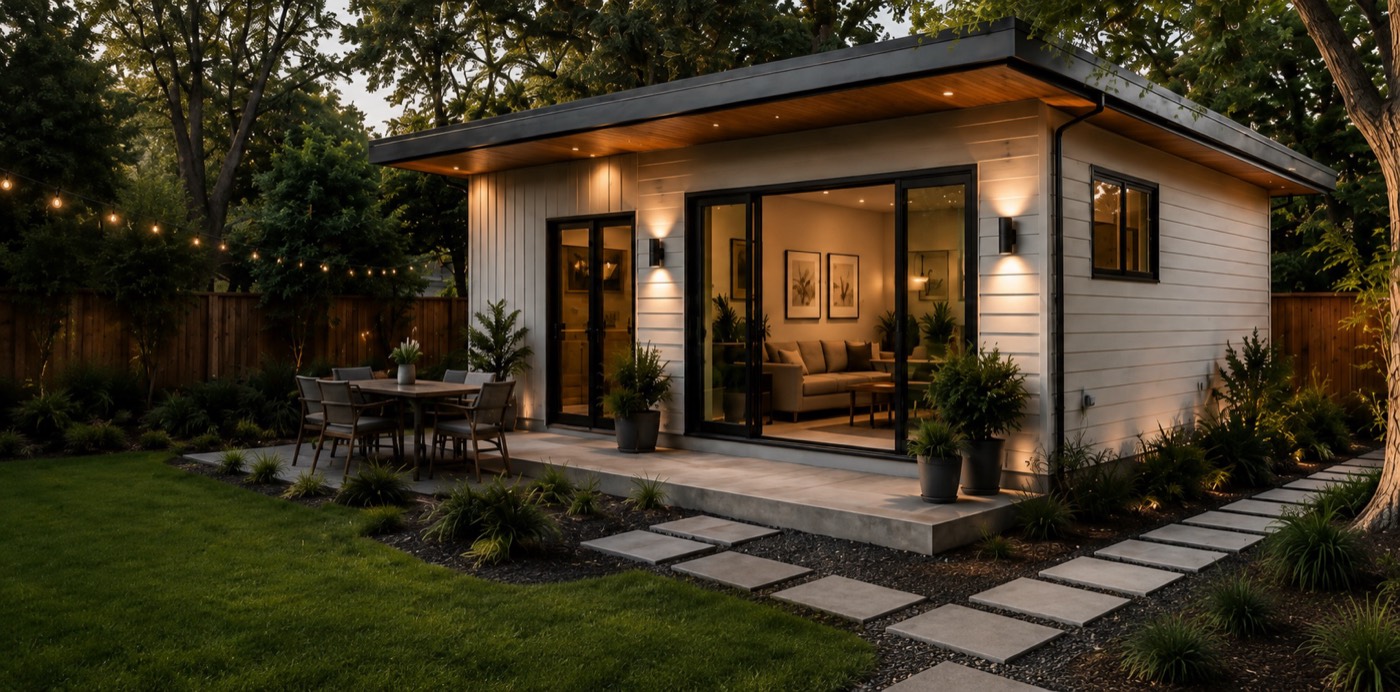
My interest in ADUs started close to home. As my dad got older, and as I watched friends navigate the same thing with their own parents, I saw how often assisted living gets treated as the default option — even when it isn't the right fit, financially or otherwise. The Home Options for Middle-Income Empowerment (HOME) Initiative changed that calculus by making ADUs a far more realistic path, and it's part of why I find this space so compelling. Beyond the senior-living angle, I'm equally interested in what these units offer everyday homeowners: a backyard office, a guest house for visiting family, or a source of rental income.
That interest led me to start looking into what it would actually take to build an ADU on my own property and I quickly realized the real starting point isn't a cost calculator, it's figuring out whether your backyard is even a legitimate candidate in the first place. From there, the picture gets more specific: what it will realistically cost, how limestone bedrock can complicate foundation work, how watershed-based impervious cover limits affect what you're allowed to build, and how protected-tree regulations can shape or shrink your buildable footprint before a single bid comes in.
How Much Does an ADU Cost in Austin?
| ADU Type | Typical Total Cost | What Drives the Range |
|---|---|---|
| Garage Conversion | $50,000 – $150,000 | The shell, slab, and roof already exist. You're paying mostly for the kitchen, bath, and code-compliant egress. |
| Prefab / Modular | $130,000 – $260,000 | The factory-built shell keeps costs predictable. Site prep, delivery, crane access, and utility hookups are billed on top. |
| Ground-Up Custom Build | $175,000 – $400,000+ | You get full control over layout and finishes. It also means paying for a complete foundation, framing, and utility build from scratch. |
Permitting and impact fees typically add $6,000 to $16,000 on top of construction, no matter which build type you pick.
Curious about size limits, FAR caps, or how many units your lot qualifies for? See our full Austin ADU Rules guide for the current regulations.
Key Local Cost Factors in Austin
National cost guides miss three things that consistently move the needle on an Austin ADU budget.
1. Soil & Foundation (Limestone / Caliche Bedrock)
Large parts of South, West, and Central Austin sit on rocky, expansive soil. A standard slab works fine in a lot of markets, but Austin lots often need engineered post-tension slabs or pier-and-beam foundations to handle the bedrock and soil movement. That's cost added before a single wall goes up. A soil test early in the process tells you which foundation type your lot actually needs.
2. Utility Connections & Metering
How you connect your ADU to water and power is a real fork in the budget.
- Shared connection (sub-metering). The ADU branches off the main house's existing lines, and a private sub-meter tracks usage. Lower upfront cost, and you may only need an electrical panel upgrade, but there's no independent billing for a tenant.
- Separate city meters. A direct connection through Austin Energy and Austin Water, with its own account. This runs higher upfront: engineered tap plans, capital recovery and impact fees, right-of-way trenching, and a second meter box. In exchange, a tenant handles their own utility bills.
Austin Water tap and impact fees vary a lot depending on which path you choose and whether your existing lines have capacity. Ask your contractor to price both options before you commit to a layout.
3. Protected Tree Mitigation
Austin protects any tree 19 inches or greater in diameter (Protected Trees), and Heritage Trees get even stronger protection at 24 inches or greater for species like oaks, pecans, and elms. If your ADU footprint falls inside a tree's Critical Root Zone, you'll need a Tree Ordinance Review Application and City Arborist approval, and at least 50% of that root zone has to stay undisturbed. On lots with mature trees, that often means a suspended (“floating”) slab or pier-and-beam foundation instead of a standard one. Where your ADU sits on the lot can change your foundation cost all by itself.
Hidden Costs Homeowners Often Forget
A few Austin-specific line items catch people off guard beyond the headline construction number.
Electrical panel upgrades
An all-electric ADU (heat pump, induction range, electric water heater) often exceeds an older home's electrical capacity. That usually means a 200-amp or 400-amp service upgrade before the ADU can even be wired.
Impervious cover limits
Austin's impervious cover limits vary by zoning district and watershed, from around 45% on a standard single-family lot down to as little as 15% in the Barton Springs Zone. Driveways, patios, and the ADU's own roof and foundation all count toward that total. A lot near its limit may need permeable pavers, rain gardens, or a smaller footprint to stay compliant.
Site access demolition and repair
Getting excavators and concrete equipment into a backyard means removing and reinstalling fence panels, repairing driveways, and re-grading torn-up turf once construction wraps. Budget a few thousand dollars for this.
Property tax impact
Building an ADU adds assessable value to your property. Texas's homestead cap normally limits increases in your home's appraised value to 10% per year. That cap does not apply to the value of new improvements in the year they're added, though. In practice, the ADU's assessed value gets added on top of your existing appraisal the year it's completed, and the 10% cap only resumes protecting your total value the following year. Ask your county appraisal district how this will actually show up on your bill. Don't assume a gentle, capped increase.
Prefab vs. Custom Stick-Built: Which Makes Sense in Austin?
Prefab or modular ($130,000–$260,000) offers tighter cost predictability and a shorter on-site build window, since most of the unit is built in a factory under controlled conditions. It works best on flat, easily-accessible lots. Austin's tree-protection and foundation requirements can complicate crane access and site prep on tighter or sloped lots.
Custom stick-built ($175,000–$400,000+) costs more and takes longer. What you get in return is a design that can actually respond to your lot: an irregular shape, a protected tree in the wrong spot, or caliche bedrock that a stock prefab design simply can't accommodate. If your lot has real constraints, this is usually the better fit.
Garage conversions ($50,000–$150,000) stay the most affordable path when you already have a garage in reasonably good structural condition, since the shell, slab, and roof are already built. The savings are real. A legal ADU conversion still needs a full kitchen, bathroom, insulation, and code-compliant egress, so it's more than drywall and paint.
How to Finance Your Austin ADU
Most homeowners don't pay for an ADU in cash. Common routes include:
- HELOC or Fixed-Rate Second Mortgage — keeps your existing low-rate first mortgage untouched, borrowing against home equity for the build.
- Cash-Out Refinance — rolls everything into one new primary mortgage; makes the most sense when current rates are close to your existing rate.
- Fannie Mae HomeStyle Renovation or Freddie Mac CHOICERenovation — both let you borrow against the future, as-completed value of your home plus ADU, rather than just its current value, and both remain active, widely used programs.
- Specialized ADU Lenders — some newer lenders underwrite based on the ADU's projected rental income, which can help the numbers work even without a lot of existing equity.
Frequently Asked Questions
What's the cheapest way to add an ADU in Austin?
A garage conversion, generally $50,000–$150,000. The shell, slab, and roof already exist, so you're mainly paying for interior build-out, utilities, and code compliance.
How much contingency should I budget?
At least 10–15% for a ground-up build. For a garage or interior conversion, go higher, 15–20%, because hidden structural, electrical, or plumbing issues behind existing walls show up more often than people expect.
Can rental income realistically offset the cost?
Yes, in a lot of cases. A well-located Austin ADU commonly rents for $1,500–$2,500 per month long-term. Depending on how the project was financed, that can meaningfully offset, or in some cases fully cover, the monthly payment on a construction or renovation loan.
What's the single biggest wildcard in an Austin ADU budget?
It's usually whichever of the three local factors above applies to your specific lot. Foundation type driven by soil conditions. Tree protection requirements. How close the lot already sits to its impervious cover limit. Two lots on the same street can land on very different budgets because of these three things alone.
Plan Your ADU with Vetted Local Builders
Ballpark numbers get you started, but your soil, your trees, and your lot's impervious cover headroom are what actually set your final price. An experienced local builder can tell you which of those apply to your property in a single site visit.
Browse our directory of vetted Austin ADU builders and suppliers →
General information only, not financial or legal advice. Costs vary by contractor, lot conditions, and finish level. Always confirm current permitting requirements with the City of Austin Development Services Department.